

Are Laser Engraved Crystals Worth It? A 2026 Guide
Sep 14th 2026
Table of Contents
- What Makes Laser Engraved Crystals Different
- The Real Reasons Laser Engraved Crystals Are Worth It
- How to Choose the Best 3D Laser Crystal Company in 2026
- Understanding Custom Crystal Award Pricing
- Laser Engraved Crystal Maintenance Tips for Long-Term Clarity
- When Laser Engraved Crystals Are Not Worth It
- Frequently Asked Questions
Last Updated: September 14, 2026
What Makes Laser Engraved Crystals Different
Laser engraved crystals are blocks of optical-grade glass or crystal holding a three-dimensional image created inside the material by a focused laser, rather than on its surface. At Crystal Prints, we've spent 22 years refining that process, and the difference between a sharp, lifelike result and a faint, cloudy one comes down to two things: the material and the method.
Optical Crystal vs. Soda Lime Glass
Optical crystal is a high-purity material with a controlled refractive index, which allows a laser to etch a clean, bright image inside it. Soda lime glass is the cheaper alternative in most mass-market keepsakes; its impurities scatter light instead of refracting it.
A soda lime piece often looks slightly green or gray, with internal details blurring together. Optical crystal stays colorless and clear, so an engraved portrait or logo reads sharply from any angle, the single biggest factor separating an heirloom-quality piece from a novelty item.
How Subsurface Engraving Creates a 3D Image
Subsurface laser engraving focuses a laser beam to a precise point inside the crystal, creating thousands of tiny micro-fractures. Each fracture becomes a visible "dot" of white; stacked together, they form a full 3D etching.
The process starts with point cloud data generated from your photo or artwork, telling the laser where to place each fracture, at what depth, and at what intensity. Laser wavelength and focus determine resolution, so a well-calibrated machine produces fine detail while a poorly calibrated one produces a coarse, dotty image.
The Real Reasons Laser Engraved Crystals Are Worth It
Laser engraved crystals are worth it when you want a keepsake that holds its appearance for decades and carries personal meaning no flat print can match. The value isn't in the material alone. It's in what the piece does that a photo frame cannot.
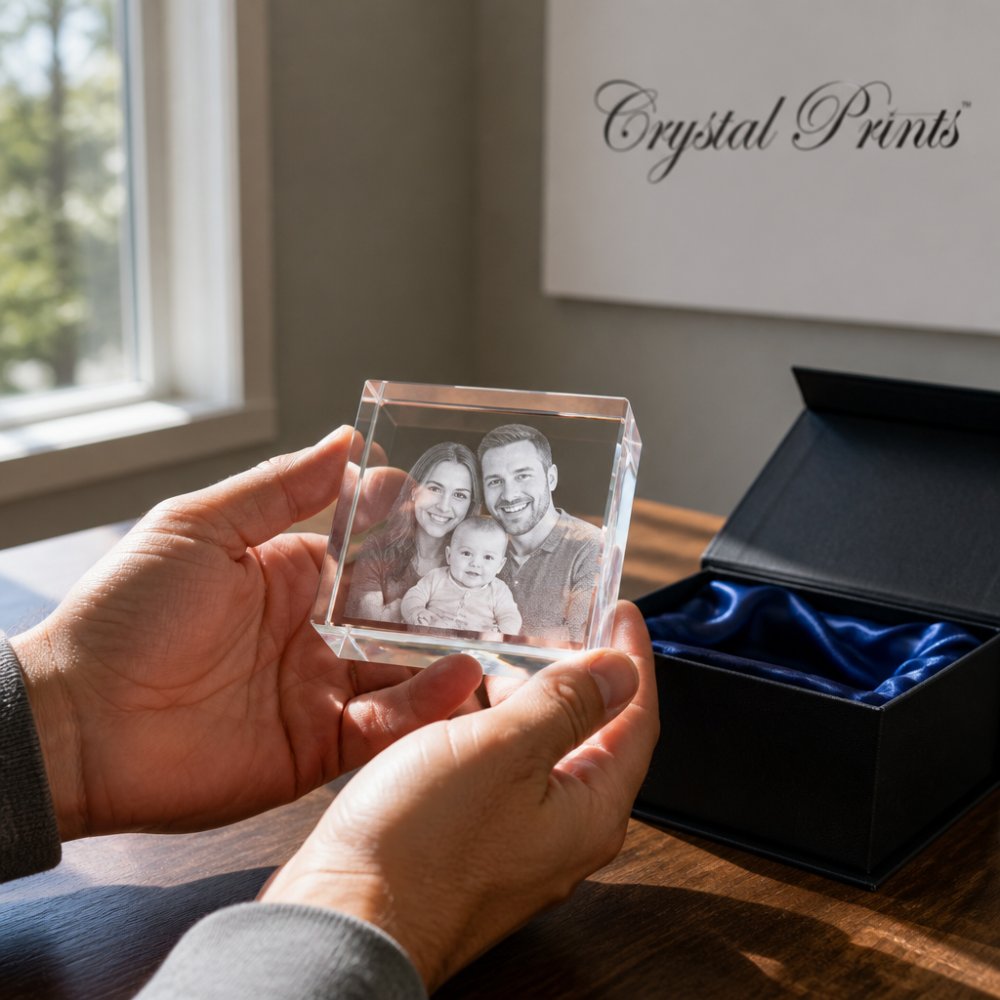
Here's what actually justifies the spend:
- Permanence. The image sits inside solid crystal, protected from scratches, fading, and yellowing. A printed photo degrades; an internal engraving doesn't.
- Presence. Because the image floats in three dimensions, it changes as you move around it. That physical quality is why these pieces work so well as memorial tributes and milestone gifts.
- Versatility. The same process handles a wedding portrait, a pet memorial, a corporate recognition award, or a company logo with equal fidelity.
- Gift-readiness. A finished piece in a velvet-lined box needs no framing or assembly. It's ready to hand over.
How to Choose the Best 3D Laser Crystal Company in 2026
Finding the best 3D laser crystal company in 2026 comes down to proof of quality, not marketing claims: ask for samples, check how they handle image editing, and confirm where the work is done.
A common mistake is judging a provider by website polish rather than output sharpness.
When you evaluate providers, weigh these factors:
| Factor | What to Look For | Why It Matters |
|---|---|---|
| Material | Optical crystal, not soda lime glass | Determines clarity and color |
| Image editing | In-house enhancement of source photos | Rescues old or low-resolution images |
| Proof approval | Digital proof before production | Prevents costly mistakes |
| Production | Clear, documented process | Consistency across bulk orders |
| Packaging | Velvet-lined gift box included | Protects the piece in transit |
For corporate orders, ask about consistency across a batch: a run of twenty awards should look identical, which only happens when a provider controls its own engraving and editing. Crystal Prints handles image enhancement in-house, which matters most with a grainy photo from decades past, good editing can recover far more detail than most people expect, but only if it happens before engraving.
Understanding Custom Crystal Award Pricing
Custom crystal award pricing depends on size, shape, engraving complexity, and quantity, so no single figure applies. The useful approach is understanding the cost drivers, realistic price bands, and how the math changes if you do it yourself.
The main variables:
- Size and volume of crystal. Larger blocks use more material and take longer to engrave; a 2x2x3-inch cube and a 5x4x8-inch block are not the same job.
- Engraving complexity. A single portrait takes less machine time than a detailed scene, a logo with fine text, or a multi-subject group photo.
- Quantity. Bulk orders usually lower per-unit cost because setup and image prep are amortized across the run.
- Image preparation. Severely degraded source photos require more editing time, and that labor is real even if it isn't itemized.
- Shape and finish. Beveled edges, custom cuts, and polished bases add fabrication steps beyond the engraving itself.
Realistic Price Bands
As a general guide, pricing depends on quantity, dates, and delivery. These are ranges, not quotes, your image and dimensions drive the final number.
The DIY vs. Professional Cost-Benefit
A desktop subsurface laser engraving machine capable of optical-crystal-quality results is a significant capital purchase, before the learning curve on point-cloud generation, focus calibration, and image prep. For a one-off gift, DIY almost never pencils out. For a business producing hundreds of awards a year, the math can flip, but only with an existing design and production workflow to feed the machine.
A practical rule: for individual pieces, professional services are often more cost-effective once you value your own time. At volume with your own artwork pipeline, in-house can make sense.
Order your personalized laser-engraved gift today →
What Drives the Quote Up or Down
- Up: multiple subjects in one piece, fine text, custom shapes, rush turnaround, heavily damaged source photos.
- Down: standard cube or rectangle shapes, single-subject portraits, bulk quantity, clean high-resolution source images.
For current pricing on a specific piece, request a quote directly, since a custom job is priced against your actual design. Treat any provider that quotes a flat rate without seeing your image with caution.
Laser Engraved Crystal Maintenance Tips for Long-Term Clarity
Laser engraved crystal maintenance tips come down to one principle: treat the surface like a camera lens. The engraving inside is permanent, but the outer surface picks up scratches, smudges, and residue that dull the whole piece. Since the real question behind "worth it" is whether the piece still looks good in ten or twenty years, it helps to understand how these items age.
How Laser Engraved Crystals Age Over 10-20 Years
The internal engraving does not fade, yellow, or wash out, because it's a physical change in the material rather than ink or dye. What changes is everything around it:
- Surface micro-scratches. Repeated wiping with the wrong cloth or cleaner slowly dulls the exterior, which scatters light and makes the internal image look hazier than it is.
- Base and LED components. On illuminated pieces, the LED module and wiring are the first thing to fail, usually within a few years, long before the crystal does.
- Adhesives and mounts. Glued bases or metal mounts can yellow or loosen, which is a cosmetic issue rather than an engraving failure.
- Environmental exposure. Prolonged direct sunlight and temperature swings stress the material and any bonded components more than the engraving itself.
A well-made optical crystal piece stored and displayed sensibly typically still reads clearly after two decades. A soda lime piece with a cheap LED base may look tired within a few years, part of why material choice matters to long-term value.
Why Engravings Sometimes Look Faint or Fail
When an engraving looks weak, the cause is almost always one of these, not time:
- Low-resolution point cloud. Too few micro-fractures from the source image or machine settings make the image read as coarse dots rather than a smooth portrait.
- Poor focus calibration. A laser not focused precisely at depth produces scattered, dim fractures instead of crisp ones.
- Material impurities. Soda lime glass scatters light internally, so the same engraving looks fainter than in optical crystal.
- Surface contamination. A hazy film of cleaner residue or hard-water spots mimics a fading engraving but wipes away.
Why Crystals Crack
Cracks are usually a handling or fabrication issue, not an engraving failure:
- Thermal shock. Moving a piece from a cold room to direct sun or a hot car stresses the material.
- Internal stress from a bad engraving run. Over-powering the laser or engraving too densely in one area leaves stress that later propagates.
- Impact at edges and corners. Beveled edges are most vulnerable; a chip there can run.
- Base seam failures. Liquid pooling in a base seam, or a glued joint under stress, can crack the piece from the bottom up.
A Maintenance Routine That Actually Protects the Value
- Dust with a soft microfiber cloth, never paper towels or rough fabric
- Clean with a mild glass cleaner or a 50/50 mix of water and white vinegar
- Spray the cloth, not the crystal, to avoid liquid pooling in any base seam
- Dry immediately with a second clean cloth to prevent water spots
- Keep the piece out of direct, prolonged sunlight and away from harsh chemicals
- Store in its velvet-lined box when not on display
Avoid ammonia-heavy cleaners and abrasive pads, which etch the surface over time. Handled this way, the internal engraving never fades, because it's sealed inside the material rather than printed on it.
When Laser Engraved Crystals Are Not Worth It
Laser engraved crystals are not worth it when the goal is a cheap, disposable token or the source image can't support a quality engraving. Being honest about that saves money and disappointment.
Skip the crystal in these cases:
- You need the lowest possible cost. A printed photo or plaque is always cheaper. Crystal earns its price through permanence; if that doesn't matter, the premium isn't justified.
- Your source image is unusable. A photo blurred beyond recovery, badly lit, or missing key detail may not engrave well no matter how much editing is applied.
- You want something you can handle roughly. Optical crystal is durable, but still glass. A piece meant to survive a toddler's playroom may be better in metal or wood.
- The recipient won't value a keepsake. For a casual acquaintance or generic occasion, a simpler gift often lands better.
The honest answer to "are laser engraved crystals worth it": they are for milestones, memorials, and recognition that deserve to last, not for filling a gift bag.
Choosing a keepsake for a wedding, a memorial, or a milestone means deciding what you want that piece to still look like in twenty years. Crystal Prints has transformed cherished photos, logos, and artwork into 3D subsurface laser-engraved crystal for over two decades, using premium optical crystal, in-house image editing, and a proprietary engraving process, with every piece delivered in a velvet-lined gift box and free shipping. If you want a keepsake built to outlast the moment it commemorates, order your personalized laser-engraved gift from Crystal Prints today.
Frequently Asked Questions
How long do 3D laser engraved crystals last?
Subsurface laser engraved crystals are designed to last for decades. Because the etching sits inside the crystal rather than on the surface, it is protected from scratches, fading, and yellowing. With proper care, including avoiding prolonged direct sunlight and extreme temperature swings, a high-quality optical crystal keepsake can hold its clarity and image detail for a lifetime and be passed down as an heirloom.
What is the difference between surface engraving and subsurface laser engraving?
Surface engraving cuts or etches marks onto the outside of the material, where they can be scratched or worn over time. Subsurface laser engraving focuses the laser beam inside the crystal to create thousands of tiny micro-fractures, forming a 3D image within the glass. This internal engraving is protected by the surrounding crystal, giving it better durability and a more dimensional, lifelike look.
What factors determine the value of a 3D laser crystal?
The main factors are image quality, material purity, and craftsmanship. Higher-resolution point cloud data and expert editing produce sharper detail, while purer optical crystal gives better clarity and light refraction. Size, shape, and the complexity of the design also affect value. A company that provides clear communication throughout the process helps ensure the final piece matches your expectations, which matters when the keepsake is personal.
Are laser engraved crystals considered high-quality gifts?
Yes, when made from optical crystal rather than lower-grade soda lime glass. Optical crystal has fewer imperfections and clearer light refraction, so the engraved image looks sharper and more three-dimensional. For milestones like weddings, memorials, or corporate recognition, a well-made crystal keepsake offers a level of personalization and permanence that a standard photo frame or plaque does not.