

Best Custom 3D Laser Crystals: 2026 Buying Guide
Sep 9th 2026
Table of Contents
- Best Custom 3D Laser Crystals: What Sets the Top Providers Apart
- Quick Comparison: Top 3D Laser Crystal Services
- How We Evaluated the Best 3D Crystal Photo Services
- The Custom 3D Laser Engraving Process Explained
- Photo Quality Requirements: How to Choose a 3D Crystal Photo
- Crystal Quality and Shapes: What to Look For
- Memorial, Anniversary, and Award Ideas for Crystal Keepsakes
- Conclusion: Order Your Custom 3D Laser Crystal Today
- Frequently Asked Questions
Last Updated: September 9, 2026
Best Custom 3D Laser Crystals: What Sets the Top Providers Apart
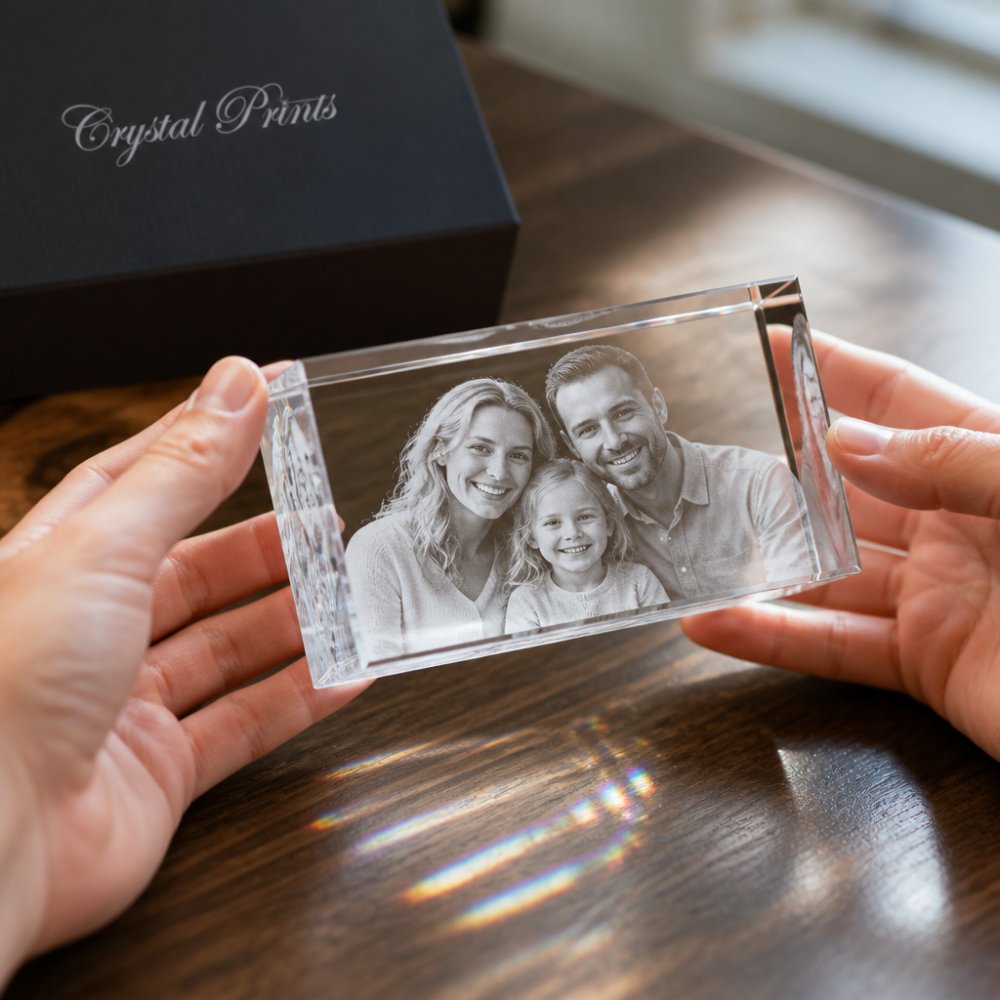
A custom 3D laser crystal transforms a flat photograph into a three-dimensional image suspended inside solid optical crystal, created through subsurface laser engraving. When you search for the best custom 3D laser crystals, most results are shopping pages that never explain what separates a keepsake that lasts generations from one that looks like a foggy paperweight.
At Crystal Prints, we have spent 22 years perfecting this craft. The difference between providers comes down to three factors: the quality of the optical crystal, the precision of the engraving systems, and the skill of the image editing team. A poor photo conversion will look flat and muddy regardless of the machine.
Quick Comparison: Top 3D Laser Crystal Services
The table below summarizes the core differentiators that matter most when commissioning a 3D laser crystal.
| Factor | What to Look For | Why It Matters |
|---|---|---|
| Engraving Method | True subsurface laser engraving | Creates depth and 3D effect inside the crystal |
| Crystal Material | High-quality optical crystal | Determines clarity and light refraction |
| Image Editing | Expert manual photo-to-3D conversion | Turns flat or grainy photos into dimensional art |
| Experience | Years of dedicated engraving work | Refines quality control and consistency |
| Presentation | Velvet-lined gift box | Protects the piece and elevates the gifting moment |
Most providers use similar machinery. The real differentiator is the human work: converting a 2D photo into a point cloud data model. A company with dedicated image editors can recover details from old, low-resolution photos that automated software might discard.
How We Evaluated the Best 3D Crystal Photo Services
To identify the best custom 3D laser crystals, we focused on four criteria. The first is engraving precision, which determines how sharp facial features appear. The second is optical clarity, since lower-grade glass can have a green tint or bubbles that distort the image. Third is the quality of the photo-to-3D conversion, which requires skilled image processing to estimate depth.
The fourth criterion is durability. A properly engraved crystal does not fade, yellow, or cloud with age. The micro-fractures are permanent and internal, so the image is protected from scratches and environmental wear.
We also weighed the ordering experience. Can you upload a photo and see a live preview? Does the company offer guidance on photo quality? The best services provide expert image editing so that even an old, grainy scan can become a stunning keepsake.
The Custom 3D Laser Engraving Process Explained
The custom 3D laser engraving process is a blend of physics and artistry, but not all laser engraving is the same. The critical distinction is between subsurface laser engraving (SSLE) and surface etching. Most low-cost options use surface etching, leaving a frosted, flat mark. SSLE focuses a laser beam inside the crystal, creating microscopic fractures at precise depth points, producing the floating, dimensional effect that defines a true 3D laser crystal.
Here is how the SSLE process works in practice:
-
Photo conversion to a point cloud: Your photograph is converted into a grayscale depth map. Specialized software interprets the brightness of each pixel to estimate depth, brighter areas are pulled forward, darker areas are pushed back. This depth map is then converted into a point cloud, which is a set of thousands of coordinate points in three-dimensional space.
-
Laser focusing and firing: The crystal is mounted on a gantry that moves along three axes (X, Y, and Z). The laser beam is focused to a specific depth inside the crystal. At each coordinate, the laser fires a short pulse. The energy at the focal point is intense enough to create a microscopic fracture, a tiny internal crack that scatters light (ieee.org). The glass itself is not melted or cut; it is fractured at a sub-millimeter scale.
-
Layer-by-layer building: The laser builds the image from the back of the crystal toward the front, or vice versa, depending on the system. Each layer corresponds to a slice of the depth map. Because the fractures are so small, the human eye perceives them as a continuous, smooth surface. The density of fractures determines the opacity of the image, more fractures mean a brighter, more solid-looking area.
The key technical trade-off is pulse energy vs. fracture size. If the pulse is too strong, the fracture becomes a visible crack that can cloud the crystal. If too weak, it is too faint to be seen. High-end systems often use Q-switched or picosecond lasers for consistent pulses. But the machine is not the only factor, the editor's skill in converting a 2D photo into a clean depth map is equally important.
Another nuance is crystal orientation. Optical crystal has internal stress lines from manufacturing. A skilled operator can orient the crystal so the laser travels along the axis of least stress, potentially reducing the risk of internal cracking, a detail that can affect durability.
For logos and text, the process is simpler. Text and vector graphics convert directly into a point cloud without depth estimation. The laser can engrave text as small as 1 mm, though the practical readability limit is around 2 mm (osha.gov).
Photo Quality Requirements: How to Choose a 3D Crystal Photo
Choosing the right photo is the single most important step. The engraving system can only reproduce the data it is given, it cannot invent detail that is not in the image.
The Ideal Photo: Resolution, Lighting, and Composition
Resolution: The minimum recommended resolution is 1 megapixel, but higher is better (nist.gov). A 12-megapixel smartphone photo is more than sufficient. A higher-resolution source gives the editor more data for the depth map, translating to sharper facial features.
Lighting: Direct, even lighting is ideal. The depth map is created from pixel brightness, so harsh shadows are interpreted as depth changes. The best lighting is soft and diffused, like an overcast day or a north-facing window. Avoid direct flash.
Composition: The subject should occupy at least 60% of the frame. A full-body shot results in a tiny face with few data points. A head-and-shoulders portrait is ideal. For group photos, ensure all faces are roughly the same size and no one is partially obscured.
Order your personalized laser-engraved gift today →
Background: A plain, uncluttered background is best. Busy backgrounds will confuse the depth-mapping software. The editor can remove a simple background, but a complex one will degrade the subject's depth map.
What to Avoid: Common Photo Problems
- Sunglasses or hats: Anything that obscures the eyes or the forehead removes critical depth data. The engraver cannot guess what is underneath.
- Heavy shadows: As noted, shadows are interpreted as depth. A photo with a strong shadow on one side of the face will produce a lopsided 3D effect.
- Low resolution: Photos smaller than 500 × 500 pixels will likely result in a blocky, pixelated engraving. The editor can upscale, but the result is often soft.
- Motion blur: A slightly out-of-focus photo cannot be fixed. The depth map will be blurry, and the engraving will look smeared.
What to Do with an Old, Grainy Photo
This is where a provider's image editing expertise matters most. Automated software often produces a muddy result from low-quality sources. A skilled editing team can use a combination of techniques to recover detail:
- Noise reduction: Software can reduce film grain and digital noise without blurring edges.
- Contrast enhancement: Adjusting the tonal curve can separate the subject from the background.
- Manual depth sculpting: An experienced editor can manually paint the depth map, adding volume to the face and hair that the automated algorithm missed.
At Crystal Prints, our expert image editing services are designed to handle these challenging photos. We have engraved portraits from 1970s film prints, faded Polaroids, and even screenshots of old photos. The key is that the editor understands how the laser will interpret the depth map and can compensate for missing data.
How to Test Your Photo Before Ordering
A reputable provider may offer a free photo review before you commit. Ask the following questions:
- Is the resolution sufficient for a clear engraving?
- Are there any shadows or obstructions that will distort the depth map?
- What will the final engraving look like compared to the original photo?
If a provider cannot answer these questions or does not offer a preview, it might be a red flag. Services like Crystal Prints provide a detailed review and will tell you if a photo is not suitable, before you pay.
Crystal Quality and Shapes: What to Look For
Not all crystal is created equal. High-quality 3D laser crystals are made from high-quality optical crystal that is free from internal bubbles, lines, and a green or yellow tint. This allows light to pass through without distortion, which is essential for the 3D effect to appear crisp. Cheaper glass can make the engraving look dull.
Consider the shape of the crystal block. Rectangular blocks are most popular for portraits, offering a large, flat viewing face. Cubes are a classic choice for smaller keepsakes. Heart shapes suit romantic gifts and memorials, while spheres or pyramids add a modern touch.
Presentation matters too. A velvet-lined gift box protects the crystal during shipping and elevates the unboxing experience.
Memorial, Anniversary, and Award Ideas for Crystal Keepsakes
The emotional weight of a 3D laser crystal makes it a powerful gift for life's most significant moments. For memorials, a crystal engraved with a portrait of a departed loved one or a beloved pet serves as a tangible, lasting tribute, designed to be displayed prominently and catch the light every day.
Anniversary gifts are another natural fit. A photo from a wedding day or family reunion becomes a dimensional keepsake that celebrates the relationship. The laser-etched image seems to float inside the glass, creating a conversation piece guests will admire.
For corporate HR managers and business owners, crystal awards are a premium way to recognize employee achievements. A company logo or personalized message engraved into a high-quality crystal block conveys a level of respect that a standard plaque does not.
Conclusion: Order Your Custom 3D Laser Crystal Today
Choosing a custom 3D laser crystal comes down to trusting a provider that masters both the technology and the artistry, a team that can handle your most precious photos, even the grainy ones from decades past, and transform them into a keepsake that remains clear for a lifetime.
Crystal Prints has been building these lasting tributes one satisfied customer at a time since 2004. Our state-of-the-art subsurface laser engraving technology, combined with expert image editing, ensures your finished piece is a true work of art. Every order arrives in a velvet-lined gift box with free shipping.
Order your personalized laser-engraved gift today and preserve your most cherished memory in a form that will outlast any printed photograph. Get started with Crystal Prints and turn your photo into an everlasting keepsake.
Frequently Asked Questions
How do I know the image quality will look good when it's enlarged and laser-engraved into the crystal?
The quality of the final 3D crystal depends heavily on the source photo. High-resolution images with clear subject separation and good lighting produce the best results. A professional service will offer expert image editing to convert your 2D photo into a 3D model, cleaning up the background and enhancing details. If you send a low-resolution or grainy image, a skilled in-house editing team can often still create a stunning keepsake, but the sharpest results come from the highest-quality original files.
What factors determine the quality of a 3D laser crystal?
Quality is determined by the optical clarity of the crystal itself, the precision of the subsurface laser engraving, and the skill of the image processing. Optically perfect crystal has no internal flaws that can distort the laser beam. Engraving precision controls the depth and density of the micro-fractures that form the image. A provider with years of experience and a proprietary engraving process can contribute to a sharper, more lifelike 3D image with proper depth perception and glass refraction.
Can you handle an old, low-resolution photo from the 80s for a memorial crystal?
Yes, expert editing services are designed for this exact scenario. While a very grainy photo presents challenges, a professional team can digitally restore details, reduce noise, and convert the subject into a clean 3D model. The key is to choose a provider that offers custom image enhancement as part of the custom 3d laser engraving process. They can often salvage a precious memory that a basic automated service would reject, ensuring your memorial tribute is as beautiful as the person you remember.
How long do 3D laser crystals actually last?
Because the engraving is subsurface, meaning it is created inside the crystal rather than on the surface, the image is protected from fading, scratching, and yellowing. The micro-fractures created by the laser are permanent. Unlike printed photos or plaques that can degrade over time, a high-quality optical crystal is essentially inert and will remain a clear, lasting heirloom for generations, making it a meaningful choice for memorial gifts and anniversary keepsakes.
Are 3D laser crystals suitable for memorial gifts?
Absolutely. 3D laser crystals are a popular and deeply respectful choice for memorials. They offer a tangible, lasting way to memorialize a loved one or a beloved pet. The 3D depth creates a lifelike presence that a flat photo cannot match. Many providers offer specific shapes like hearts or teardrops, and the velvet-lined gift box presentation adds a sense of ceremony, making it a fitting tribute for a funeral, memorial service, or a private moment of remembrance.