

Do 3D Laser Crystals Fade Over Time?
Posted by Editorial Team on on Oct 10th 2026
Table of Contents
- How 3D Laser Engraving Works Inside Crystal
- Do Crystals Fade in Sunlight?
- How Long Do 3D Laser Crystals Last?
- Durability and Permanence of Laser-Engraved Points
- How to Clean 3D Laser Crystals
- Display Lighting and How Light Affects Visibility
- Practical Care and Troubleshooting
- Frequently Asked Questions
Last Updated: October 11, 2026
How 3D Laser Engraving Works Inside Crystal
3D laser engraving creates images deep inside crystal by focusing a laser beam at precise depths to form thousands of tiny dots that scatter light in specific patterns, forming the visible image, and because the engraving is a permanent physical structure, 3D laser crystals fade never, remaining sharp indefinitely.
The laser causes controlled fractures at exact points inside the material, making the engraving permanent and protected by the surrounding crystal.
K9 crystal, an optical-grade glass, is the standard material because its transparency allows light to pass freely, making the internal engraving visible from any angle.
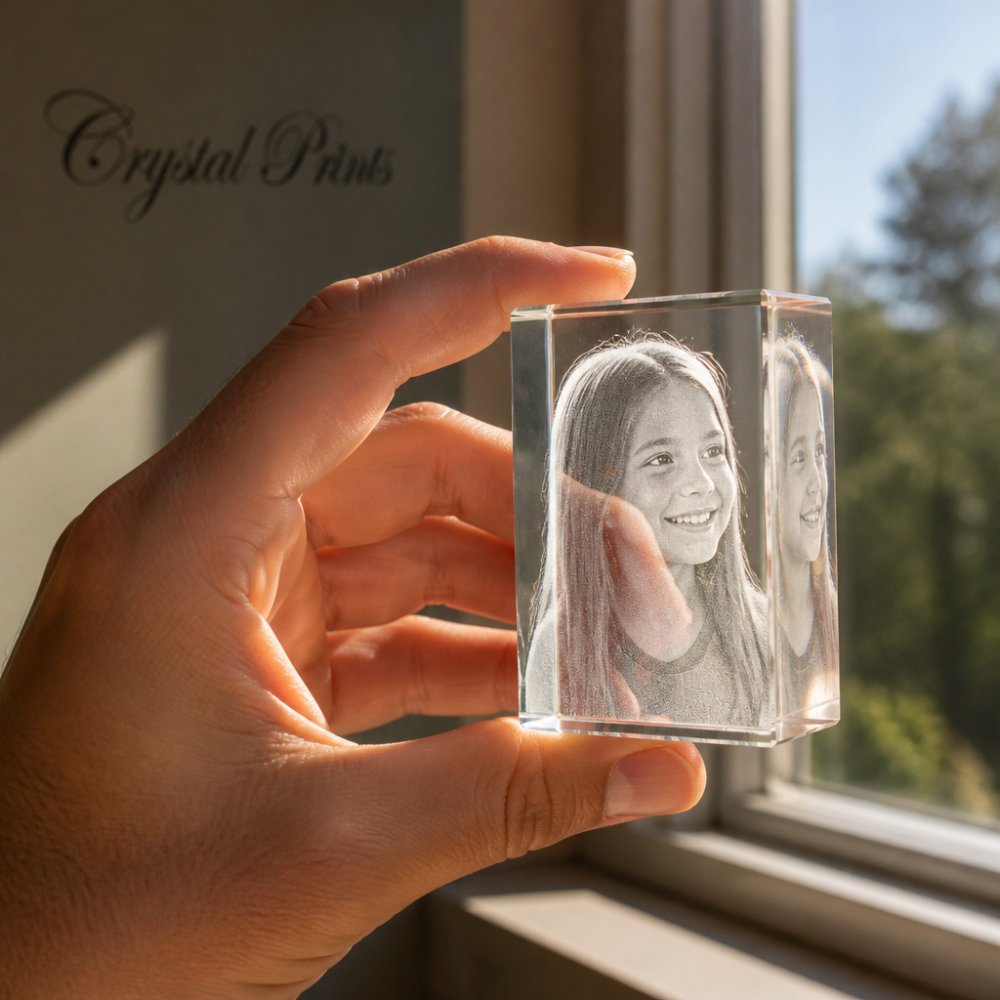
Most 3D laser crystals are engraved 2-8mm below the surface, protecting the image from dust, fingerprints, and surface scratches.
Do Crystals Fade in Sunlight?
3D laser crystals do not fade from sunlight exposure. The engraving is created by permanent physical damage to the crystal structure, microscopic fractures, not by dyes, inks, or coatings that degrade under UV light. Sunlight cannot reverse or diminish the laser-created fracture points inside the material.
Effects on the engraved image: None. The internal laser points are protected and unaffected by UV exposure or heat.
Effects on the crystal material itself: K9 crystal is UV-stable and does not yellow, cloud, or become brittle. Centuries-old museum pieces demonstrate the material's stability across human timescales.
Effects on visibility and appearance: Direct sunlight creates glare that temporarily obscures the image, a visibility issue, not fading. Dust accumulation in sunny locations reduces clarity temporarily but cleaning restores full visibility.
Effects on display bases and LED components: Wooden bases may fade or warp, metal finishes may tarnish, and LED bases may have reduced lifespan if exposed to sustained temperatures above 140°F (60°C). The crystal itself remains unharmed.
Practical sunlight placement: Indirect natural light or soft sunlight works well for display. Position the crystal where light passes through it without creating surface glare. Avoid placing crystals directly in front of south-facing windows in hot climates or in direct afternoon sun for 8+ hours daily if the base contains electronic components.
How Long Do 3D Laser Crystals Last?
3D laser crystals are designed to last indefinitely. The internal engraving cannot degrade because it's protected inside the crystal and created through permanent physical change, not chemical reaction or surface coating. However, understanding what does and does not change over time helps set realistic expectations.
What does not change: The laser-engraved points are permanent and cannot fade, blur, or disappear. Environmental factors like humidity and temperature do not affect them. K9 optical glass does not become brittle, cloud, or yellow over decades or centuries.
What can change: Several factors can affect the overall appearance or functionality of a crystal display over time:
-
Surface scratches: Light scratches don't affect the internal engraving but may reduce optical clarity. Deep scratches require professional polishing.
-
Dust and residue buildup: Surface film reduces visibility but is easily reversed with cleaning.
-
Display base degradation: Wooden bases may warp, crack, or fade with extreme temperature swings or prolonged moisture exposure. Metal stands can tarnish. Velvet-lined boxes may wear or fade. These are cosmetic changes that don't affect the crystal itself.
-
LED light base lifespan: Most LED light bases are rated for 25,000-50,000 hours of operation (roughly 3-6 years of continuous use, or 10-20 years of typical daily use). After this period, LEDs may dim or fail, requiring base replacement. The crystal remains perfect; only the lighting component needs updating.
-
Extreme environmental stress: Crystals exposed to sustained temperatures above 140°F (60°C) or below 32°F (0°C), repeated freeze-thaw cycles, or harsh chemical environments face different risks. Extreme heat can potentially affect display bases or LED components, but the crystal and engraving remain stable. Repeated thermal shock (rapid temperature changes) is theoretically more stressful than steady-state temperature, though K9 crystal is formulated to resist thermal stress.
Realistic lifespan expectations: A 3D laser-engraved crystal kept indoors in normal conditions will maintain its engraved image and optical clarity for a human lifetime and beyond, 50, 100, or 200+ years. The crystal itself is the permanent part. Display components (bases, boxes, LED lights) may require maintenance or replacement within 10-20 years depending on use and environment. The engraving will never fade, blur, or degrade, making the crystal itself a true heirloom.
Durability and Permanence of Laser-Engraved Points
The laser-engraved points inside crystal are permanent because they represent actual structural changes in the material. The laser creates microscopic fractures at precise locations. These fractures scatter light, forming the image. Once created, they cannot be reversed by any environmental factor.
Permanence comes from the physics of the process. The crystal's molecular structure is altered at the point of laser impact. This alteration is not reversible through heat, light, humidity, or age. It's as permanent as a scratch etched into glass, except the laser points are inside the material, protected from external wear.
K9 crystal's stability ensures the surrounding material doesn't degrade. The crystal won't become cloudy or brittle around the engraved areas. The optical clarity remains constant, so the contrast between engraved and non-engraved areas stays sharp.
Durability also depends on the quality of the original engraving. Precise laser calibration and high-resolution image data create crisp, clear points. Poor calibration or low-resolution source images result in fuzzy engraving that may appear less distinct over time, but this is a visibility issue at the moment of creation, not a fading issue that develops later.
Order your personalized laser-engraved gift today →
How to Clean 3D Laser Crystals
Dust and fingerprints accumulate on the crystal's surface and reduce image clarity. Cleaning is simple and safe for the engraved interior.
Use a soft, lint-free cloth, microfiber works best. Gently wipe the crystal's exterior surfaces. Avoid harsh scrubbing, which can scratch the surface.
For stubborn fingerprints or dust, dampen the cloth slightly with distilled water. Wipe gently and dry immediately with a second clean cloth. Never use tap water, which contains minerals that leave spots.
Avoid commercial glass cleaners. Many contain ammonia or alcohol that can damage finishes on display bases or velvet-lined boxes. Stick to water and soft cloths.
Never use abrasive materials like paper towels, tissues, or rough cloths. These can create fine scratches on the crystal surface. Scratches don't affect the internal engraving, but they do reduce the crystal's optical clarity and shine.
Store the crystal in its original velvet-lined box when not on display. This protects it from dust accumulation and accidental contact.
Display Lighting and How Light Affects Visibility
The way you light a 3D laser crystal dramatically affects how clearly you see the engraved image. Internal engraving depends on light passing through the crystal and reflecting off the laser-engraved points. The right lighting makes the image pop. Poor lighting makes it nearly invisible.
LED light bases are ideal. They sit beneath or behind the crystal and direct light upward through the engraved interior. This creates strong contrast between the lit engraved points and the transparent crystal around them.
Ambient room light alone is usually insufficient. A crystal sitting on a shelf in normal room lighting may look blank or barely visible. The same crystal under LED backlighting becomes stunning. This isn't fading, it's a lighting limitation.
Sunlight can work but creates challenges. Direct sunlight produces glare on the crystal's surface, which actually hides the internal image. Indirect natural light or soft sunlight works better. Position the crystal where light passes through it without hitting the viewing surface directly.
Avoid placing crystals directly in front of bright windows or harsh light sources. The glare washes out the engraved image. Instead, position the crystal where light comes from the side or behind.
Practical Care and Troubleshooting
Image appears faint or barely visible: This is almost always a lighting issue. Try placing the crystal under an LED light base or in softer, indirect light.
Surface scratches or cloudiness: These affect the crystal's exterior, not the internal engraving. Minor scratches don't impact the image quality noticeably. For light surface haze, try cleaning with a microfiber cloth.
Dust inside the crystal: This is extremely rare. K9 crystal is sealed during the engraving process, so dust cannot enter. If you see particles inside, the crystal may have a manufacturing defect. Contact the provider for replacement.
Base or display box damage: The internal engraving is unaffected by damage to the base or box. The crystal itself remains permanent and unchanged. You can replace the base or reframe the crystal if the display components wear out.
Discoloration or yellowing: K9 crystal does not yellow from age or sunlight. If a crystal appears discolored after years of display, it's likely surface dust or film buildup, not material degradation.
Crystal feels warm or hot: Crystals can warm up under strong LED light bases or in direct sunlight. This is normal and doesn't harm the engraving. It's simply heat transfer from the light source. The crystal's internal structure is unaffected.
Do 3D laser crystals fade over time? No. The engraving is a permanent physical structure created inside the crystal. It cannot fade, blur, or degrade.
Frequently Asked Questions
Do 3D laser crystals fade over time?
3D laser-engraved crystals do not fade in the traditional sense. The engraving is created by laser-etched points inside the crystal material itself, not on the surface. These internal laser-engraved points are permanent and do not deteriorate chemically. However, visibility can appear reduced if the crystal accumulates dust, fingerprints, or if the display lighting is insufficient. Proper cleaning and adequate illumination restore full visibility. The K9 crystal material used in quality engraving is optically stable and resistant to yellowing or cloudiness over decades.
Can sunlight damage a 3D laser-engraved crystal?
Direct sunlight does not fade or damage the internal laser-engraved image itself. The engraving points are created deep within the crystal structure and are not affected by UV exposure or heat from sunlight. However, prolonged direct sunlight exposure can cause the crystal display base or surrounding materials (such as velvet backing or wooden stands) to fade or degrade. For maximum longevity, avoid placing crystals in direct sunlight for extended periods. Ambient light, LED lighting, or indirect natural light preserves both the crystal and any accompanying display materials.
How long do 3D laser crystals last as keepsakes?
Quality 3D laser-engraved crystals are designed to last for decades as permanent keepsakes. The K9 optical crystal material is chemically stable and does not degrade, yellow, or cloud over time when properly maintained. The internal laser-engraved points remain unchanged indefinitely. With basic care, keeping the crystal clean and protected from extreme temperature fluctuations or physical damage, a laser-engraved crystal can serve as a lasting heirloom for generations. The longevity depends on material quality, manufacturing process, and how well the piece is cared for and displayed.
What causes a laser engraving to look less visible?
Reduced visibility of a 3D laser engraving is typically caused by dust, fingerprints, or surface scratches on the crystal, not by fading. Insufficient lighting also makes the internal engraved points harder to see. The laser-etched image depends on light refraction and reflection through the crystal to display the image. Weak ambient light or poor display positioning reduces the visual impact. Cleaning the crystal gently and improving illumination (with a light base or repositioning near a light source) restores full visibility. The engraving itself remains intact.