

Where to Buy USA Made Crystals: A 2026 Guide
Sep 16th 2026
Table of Contents
- Why USA Made Crystals Are Worth Seeking Out
- How to Verify a Crystal Supplier Is Actually Based in the USA
- Geological Verification of Domestically Mined Stones
- Where to Buy USA Made Crystals Online and in Person
- Custom Laser Engraved Corporate Awards: A Practical Option for Recognition
- High-Quality Optical Crystal Awards and Personalized 3D Crystal Keepsakes
- Price-Per-Gram Transparency: What Your Money Actually Buys
- Conclusion
- Frequently Asked Questions
Last Updated: September 16, 2026
Why USA Made Crystals Are Worth Seeking Out
Buying crystals labeled "USA made" is trickier than it sounds, because the label can mean three different things: a stone mined on American soil, a stone cut and polished here, or a piece simply assembled or packaged domestically. Knowing where to buy USA made crystals starts with understanding that distinction, and this guide from Crystal Prints walks through how to verify it before you spend money.
The gap between marketing language and reality is wide. Many listings use "made in the USA" loosely, and a surprising number of stones sold as domestic actually arrive from overseas and get repackaged once they land.
How to Verify a Crystal Supplier Is Actually Based in the USA
Verification is a paperwork exercise, not a vibe check. A supplier that is genuinely based domestically can show you an address, a registration, and a paper trail without hesitation.
Checking Business Registrations and Physical Addresses
Look up the business name in the state's Secretary of State business registry, which is public and free to search. A legitimate operation will appear there with a registered agent and a physical address, not just a mailbox drop.
Reading Labels: Assembled vs. Mined Domestically
"Assembled in the USA" and "mined in the USA" are legally and practically different. Assembled means the raw stone came from somewhere else and was mounted, polished, or packaged here.
| Label Wording | What It Actually Means | Verification Method |
|---|---|---|
| Mined in the USA | Stone extracted from domestic deposits | Ask for the quarry or claim name |
| Cut and polished in the USA | Imported rough, domestic finishing | Request the rough's country of origin |
| Assembled in the USA | Imported stone, domestic mounting | Check the stone's stated origin separately |
| Made in the USA | Vague; can mean any of the above | Ask the seller to specify which stage |
Geological Verification of Domestically Mined Stones
Domestic origin is a geological claim, and it can be tested. Certain minerals have recognizable regional signatures, and a trained eye can often tell where a specimen came from based on its matrix, color zoning, and associated minerals.
Where to Buy USA Made Crystals Online and in Person
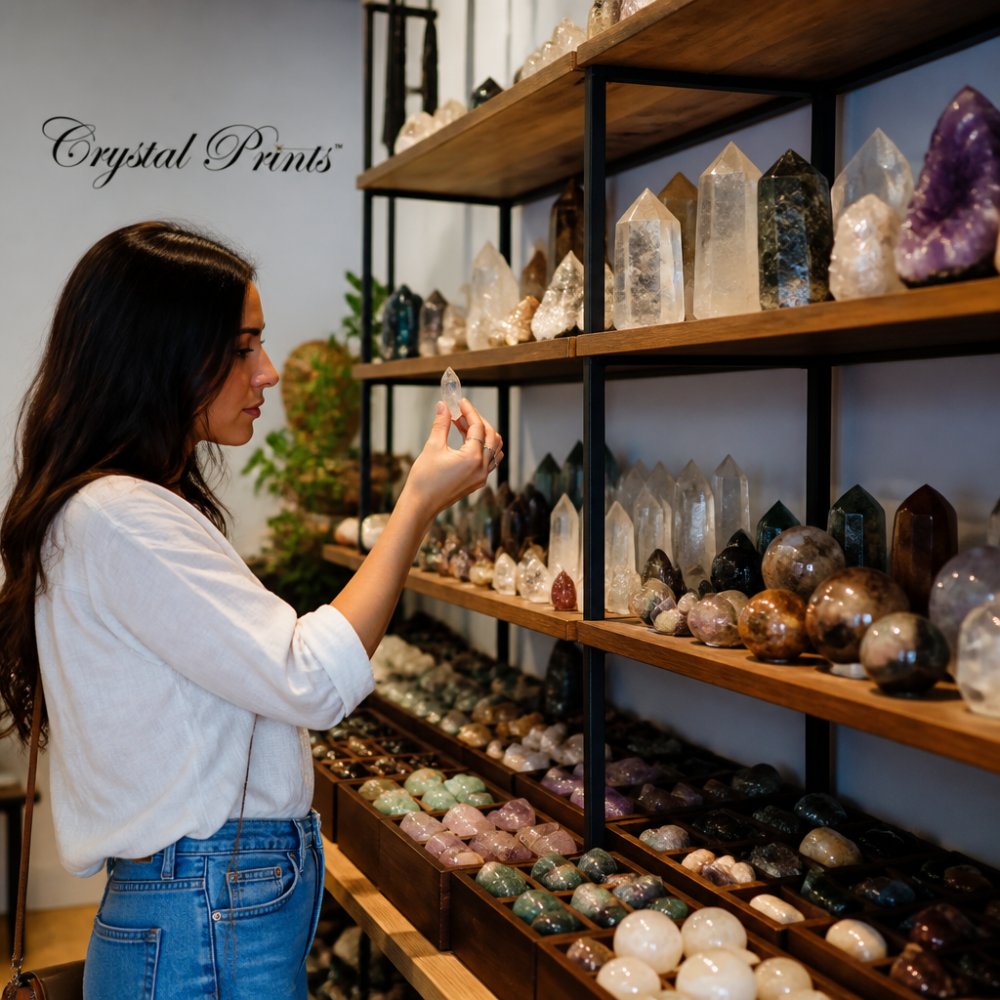
Buying domestically sourced crystals happens through four main channels: online marketplaces, specialized artisans and small domestic sellers, physical rock shops, and gem and mineral shows. Each has real trade-offs, and the right one depends on whether you are buying a single display piece or sourcing in bulk.
Online Marketplaces and Specialized Artisans
Large marketplaces offer the widest selection and the weakest verification. Individual sellers set their own standards, origin claims go largely unchecked, and the same listing photo often appears across dozens of storefronts. That is fine for a low-cost tumbled stone, but it is a poor fit when provenance matters.
Rock Shops, Gem Shows, and Local Makers
Physical shops let you inspect a stone before buying, which matters for both quality and authenticity. You can check weight in hand, look for dye or resin treatment under a loupe, and ask the staff where a specimen came from. A shop that has been in business for years usually has direct relationships with domestic diggers and cutters, and that relationship is the provenance.
A Note on Buying From Domestic Dig-Your-Own Sites
Several domestic mines operate public dig sites where you pay a fee and keep what you find. This is the only channel where you personally witness the extraction, which makes provenance self-evident. The trade-off is that you get what the site produces, not what you want, and the material is usually unpolished rough. For buyers who value certainty over selection, it is the strongest verification method available.
Custom Laser Engraved Corporate Awards: A Practical Option for Recognition
When recognition matters, the material and the personalization both carry weight. Custom laser engraved corporate awards turn a standard plaque into something an employee actually keeps, because the engraving is specific to them.
Pricing depends on size, quantity, and turnaround.
Order your personalized laser-engraved gift today →
High-Quality Optical Crystal Awards and Personalized 3D Crystal Keepsakes
Optical crystal is the material that makes a 3D engraving readable. It is clearer than standard glass, which is why an image suspended inside it stays sharp instead of looking cloudy.
Price-Per-Gram Transparency: What Your Money Actually Buys
Price-per-gram is the clearest way to compare crystal purchases, and almost no seller publishes it. That silence is the point. Most wholesale suppliers hide pricing behind a login, and most retail listings quote a flat price with no weight, which makes cross-seller comparison impossible. This section does what the rest of the market will not: it shows you how to build the number yourself and what drives it up or down.
How to Calculate It
- Weigh the piece on a kitchen scale and record the grams
- Divide the total price by the gram weight
- Compare that figure across sellers for the same mineral type
- Note whether the price includes cutting, polishing, or engraving
- Flag any listing that will not state a weight at all
A polished specimen and a raw mineral at the same price per gram are not equivalent, because the labor differs. What matters is comparing like with like: same mineral, same formation type, same level of finishing.
What Actually Moves the Number
Four factors drive price per gram, and knowing them tells you whether a quote is reasonable or inflated:
- Mineral rarity. Common domestic material such as clear quartz, amethyst, and pyrite is abundant and cheap per gram. Rarer domestic species and unusual color varieties command more because supply is thin.
- Formation type. A natural point, a polished tower, a sphere, and a tumbled stone from the same rough carry very different per-gram prices, because the labor and the material loss differ enormously. Spheres waste the most rough; tumbles waste the least.
- Clarity and color saturation. Two pieces of the same mineral from the same mine can differ several times over in per-gram price based on internal clarity and depth of color. This is the single biggest variable and the hardest to judge from a photo.
- Provenance. A documented domestic mine origin adds a premium over an unlabeled stone of identical appearance. You are paying for the paper trail, not the geology.
Why Domestic Material Costs More Than Imported
Domestic mining carries labor, permitting, and reclamation costs that overseas operations often do not. That cost shows up in the per-gram price, and it is the main reason a domestic quartz point costs more than an imported one of similar size. The premium is real, but it is not unlimited, if a domestic piece is priced at many multiples of a comparable imported piece, ask what specifically justifies it.
A Worked Comparison
Take two clear quartz points of similar size, one domestic and one imported, both listed at the same flat price. If the domestic piece weighs less, its per-gram price is higher, and you are paying a provenance premium. If the imported piece weighs less, the domestic one is the better value on a per-gram basis. Without the weights, you cannot tell which is which, which is exactly why sellers omit them.
Conclusion
The hard part of buying domestic crystals is not finding sellers, it is finding sellers who can prove what they claim. Ask for the mine name, check the business registry, and calculate price-per-gram yourself before you commit.
Frequently Asked Questions
How can I verify if a crystal supplier is based in the USA?
Check the business registration through your state's Secretary of State database, look for a physical US address on the website (not just a PO box), and call the listed phone number. Reputable USA made crystals sellers will answer questions about where their stones are mined and processed. If a supplier cannot clearly explain their sourcing or provides only vague answers, treat that as a warning sign. Cross-reference the business name with public records and reviews before purchasing.
What is the difference between raw mineral sourcing and USA-made crystal products?
Raw mineral sourcing refers to where the stone was physically extracted from the earth. USA-made crystal products means the finished item, whether a polished tower, tumbled stone, or engraved keepsake, was cut, shaped, and completed domestically. A crystal can be mined overseas but still become a USA-made product if it is cut and finished here. Ask suppliers to clarify both the mining origin and the manufacturing location so you know exactly what you are buying.
Are there reputable online shops for American-made crystal awards?
Yes, several US-based companies specialize in crystal awards and keepsakes. Look for businesses with a verifiable US address, clear production descriptions, and a track record of customer reviews. Crystal Prints, for example, has operated since 2004 and produces personalized 3D crystal keepsakes and corporate awards using sub-surface laser engraving. Request samples or view detailed product photos before placing a large order, especially for corporate recognition programs where consistency matters.
How does 3D subsurface laser engraving affect crystal quality?
Subsurface laser engraving creates tiny fractures inside the crystal without cutting or damaging the surface. This means the engraved image is permanently sealed inside the glass, protected from scratches, fading, and moisture. High-quality optical crystal is used because it is clear and free of bubbles that would distort the engraved image. The result is a durable keepsake that will not yellow or cloud over time, making it suitable for memorials, awards, and milestone gifts intended to last generations.